DP / PATEL
All Projects

Team Project — Industrial Automation

PLC-Controlled Lava Lamp Production Line

A team-built PLC-controlled lava-lamp bottling line — ladder-logic state-machine control for dual-fluid filling, sealing, inspection, and packaging — simulated end-to-end in Factory I/O.
Industrial AutomationPLCFactory I/OLadder LogicState Machines
PLC-Controlled Lava Lamp Production Line
01

Overview

A four-person industrial-automation project: a PLC-driven production line for filling, sealing, inspecting, and packaging lava-lamp bottles, simulated in Factory I/O against a written request-for-tender. My work focused on the PLC ladder logic, the Factory I/O simulation build, and testing/debugging the automation sequence.

02

Team Project & My Contribution

This PLC-controlled lava-lamp production line was a four-person industrial-automation project. The team developed the full simulated process — conveyor sequencing, dual-fluid filling, sealing/stamping, inspection and rejection, packaging, buffer management, and the safety interlocks. My work focused on the PLC ladder logic, the Factory I/O simulation build, and testing the automation sequence — not the mechanical layout of every simulated station.

  • PLC ladder-logic development — the state-machine control (Idle → Fill T0 → Fill T1 → Seal → Pick-and-Place → Inspect → Sort → Reset), interlocks, and anti-repeat protection.
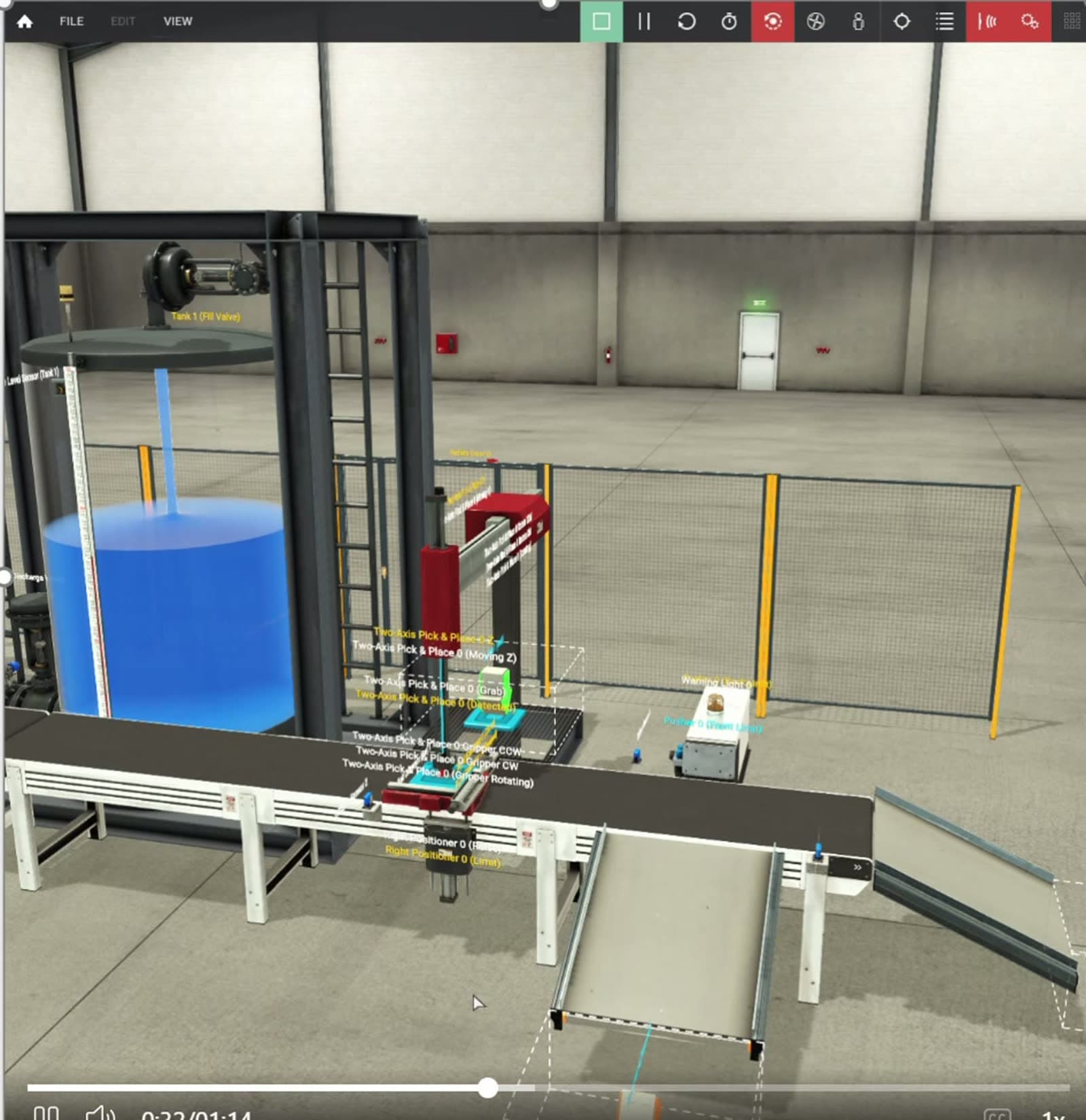
  • Factory I/O simulation development and integration — building and wiring the digital-twin line (emitter, conveyors, fill tanks, pick-and-place, pusher, chute) to the ladder logic.
  • Sequence implementation — the timer-driven fill, seal, and pick-and-place motion sequences.
  • Automation logic testing and debugging across the full simulated cycle.
03

System Architecture

Linear Conveyor (6 m)

VFD-driven main transport across sequential modular stations

Dual Fill Stations

PLC-timed valve actuation for Solution 1 and Solution 2

Sealing & Pick-and-Place

Pneumatic clamp with a two-axis pick-and-place lid placement sequence

Inspection Station

Sensor-based pass/fail check with pusher-actuated rejection

Buffer Zones

Queuing logic reconciling ~30 s bottle arrivals against ~27 s box arrivals

Safety Layer

Hardwired E-stop, light-curtain interlock, fail-safe PLC logic

04

Testing & Results

  • The simulated line met its target cycle time of approximately 28 seconds per bottle, validated inside Factory I/O.
  • Buffer and queue logic kept the line running continuously despite the bottle (30 s) vs. box (27 s) arrival mismatch, with no physical backlog observed in simulation.
  • Station sequencing was verified correct across repeated runs — no double-filling or out-of-order behavior.
  • Fault-handling logic (jam detection, overfill cutoff, seal-failure hold) was exercised in simulation and returned the line to a safe state each time.
05

Challenges & Limitations

  • This is a Factory I/O simulation, not a physical build — some real components (packaging machinery, a true vision-inspection camera) were represented with placeholder simulation blocks rather than physical hardware.
  • The simulation doesn't model real fluid dynamics, so fill-accuracy results are logic-level (timer- and sensor-based), not physically measured.
  • Cost estimates in the underlying project report were based on standard industrial benchmarks rather than vendor quotes for this specific build.
06

Gallery

Factory I/O simulation — lava-lamp bottle infeed through dual-fluid filling and pick-and-place stamping (muted, trimmed clip)